This is the Duluth Mushroom House. Sometimes it's called The Flintstones house because of its resemblance to the architecture on The Flintstones. This 5-bedrooom, 3-bathroom architectural wonder is now for sale.

This is the Duluth Mushroom House. Sometimes it's called The Flintstones house because of its resemblance to the architecture on The Flintstones. This 5-bedrooom, 3-bathroom architectural wonder is now for sale.

The story of the Space Race as most of us know it is that the Soviet Union was the first to launch a satellite into orbit in 1957 and the first to launch a human into orbit in 1961. The Americans scrambled to catch up, and won the big goal of landing astronauts on the moon in 1969. It was only years later that we learned what else the Soviets did, because they weren't keen on sharing information and they pulled most of their funding for space exploration after the Apollo moon landing.
The world eventually learned about the Lunokhod program, in which the USSR was the first to land remote-controlled robots on the moon in 1970 and 1973. The US didn't do that until Sojourner landed on Mars in 1997. Lunokhod 1 and 2 were equipped with a reflector that bounced laser signals from earth and back to relay information. The rovers also moved, unlike reflectors left by the Apollo missions. While Lunokhod 2 continued to reflect signals after its mission ended, Lunokhod 1 was lost for almost 40 years. No one knew how far the rover had traveled before its power died.
Then in 2010, the Lunar Reconnaissance Orbiter (LRO) determined the exact coordinates of Lunokhod 1, and researchers at the Apache Point Observatory in New Mexico were able to bounce laser signals off its reflector. The results were better than signals from Lunokhod 2, showing us that the reflector was still in good shape. Read about the lost and found Soviet robot on the moon at Daily Galaxy. -via Damn Interesting
(Image credit: Музей Космонавтики)
Japanese Instagram user konel_bread creates amazingly realistic baked goods that look like animals and cartoon characters. In the past, we've seen their loaves that look like teddy bears with six pack abs. Now, they show something more sedate but equally charming: bagels prepared to resemble dozing wiener dogs.

A trend on X lately is to share photos of historically significant buildings that have been preserved by being repurposed by modern businesses. Not all of the descriptions are correct. For example, I've verified that a particular Chipotle was not the place where Thomas Paine wrote Common Sense. But this Publix grocery store is indeed an old government printing house.
501 Gervais Street in Columbia, South Carolina is the site of a brick building where the Confederacy printed fiat currency until February of 1865, when General Sherman burned it. It was rebuilt after the war and is now a grocery store.
It's interesting to watch these changes in real time. There's a beautiful historic building in the small town of Marion, Texas. I drive by it a few times a year. It's lately been a coffeshop, but changes every couple of years.
Photo: Ron Cogswell
Every ellipse has two foci. The foci are, Khan Academy tells us, "two points whose sum of distances from any point on the ellipse is always the same."
Let's say that you build a miniature golf course shaped like an ellipse and place the hole at one focus. If you hit the ball from the other focus with a bank shot, the ball will land in the hole. If you hit the ball from any other point with a bank shot, the ball will miss the hole.
That's the premise of this video by YouTuber Constructive Chaos. He build increasingly complex combinations of ellipses to make mathematically predictable miniature golf course.
-via The Awesomer
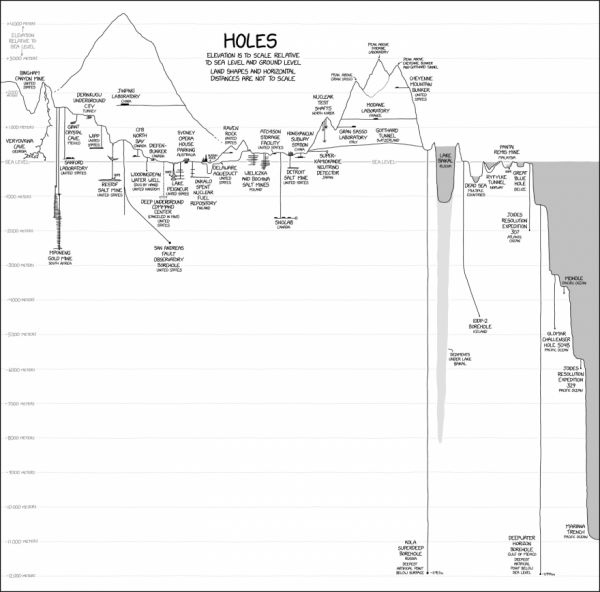
The latest hypothetical question for the What If? series by Randall Munroe and Henry Reich (previously at Neatorama) asks how long it would take a bowling ball to fall from the ocean surface to the bottom of the Mariana Trench. The trench is the deepest part of the world's oceans, and the point called Challenger Deep is around 11,000 meters or 36,000 feet deep. A bowling ball would take quite a while to sink that far.
But wait- the real surprise here is that it might not sink at all. It might float! That depends on how heavy the ball is. Galileo told us that a hammer and a feather will drop at the same rate if you control for air resistance, like doing it on the moon or in a vacuum chamber. Apparently, physics doesn't work like that underwater, so we find out how objects of different weights would fall in the ocean. But let's don't do this, because that would be littering.
Bharat Kalicharan Yadav (known as Akku) was brought into a courtroom in Maharashtra, India, in August of 2004 for the purpose of setting bail. Before any procedure could begin, dozens of women rushed to Yadav and began attacking him. He was stabbed more than 70 times, and parts of his body were cut off. Chili powder was forced into his face and mouth. And all this was after he had gone to the police for protection.
Yadav had terrorized the poor neighborhood for 13 years by then. He had killed at least three people and raped more than 40 women and girls as young as ten. Yadav led a gang and paid off police. He had been arrested 13 times prior to the deadly attack, but had walked free each time. The mob attack was the culmination of years of abuse on an entire community. But now what? When the judge regained order, he asked who had attacked Yadav, and every woman in the courtroom raised her hand. After years of investigation, 21 people were charged in Yadav's death. Read the story of Akku Yadav and what happened afterward at Utterly Interesting.
Language is a funny thing. It changes over time, and the exact meaning of a word can drift to become more broad or more specific, or something else completely. That confusion can spill over into a courtroom, when the exact wording of a law is debated. Does a more modern interpretation of those words change the intention of those who originally passed the law? And how do we determine exact meanings- by the current dictionary, the generally-understood meaning at the time the law was written, or how the wording of the law is understood today? It depends on how you look at it, or even more importantly, who looks at it. Dr. Erica Brozovsky (previously at Neatorama) breaks down the legal battle over words, and bfings us some court cases where a definition made all the difference. All I could think of while watching this is a quote: "It depends on what the definition of 'is' is."

The American colonists who fought against Britain for independence had help from other countries, mostly notably France, but others as well. The British Empire had plenty of enemies, and people all over liked the idea of fighting for freedom. One of those helpers was a small group of Jewish settlers on an island in the Caribbean.
St. Eustatius is now more often called Statia, and it's a part of the Caribbean Netherlands, along with the islands of Bonaire and Saba. In the 18th century, up to 40% of the thousand or so residents of St. Eustatius were Jewish refugees who had found safe haven in the Netherlands and continued on to settle in the New World. Some of them built a lucrative trade network with both Europe and the American colonies, which included smuggling gunpowder to the Continental Army. The British were so upset that they raided St. Eustatius, looted the Jewish community of its wealth, and confiscated all the adult men they could find to send them into exile without their families. Now a new history exhibit is hoping to bring light to this forgotten chapter of American history. Read about the Jewish smugglers who aided the patriots at Smithsonian.
(Image credit: Jrryjude)

Aynsley Grealis is a fabrics artist in Toronto who makes inventive sculptures, often practical, with crochet techniques. Here, for example, is a a handbag shaped like New York City's famous pizza rat that was filmed moving through the subway system with a slice of pizza.
The Shiki Theater Company is the biggest such company in Japan, and they have a longstanding partnership with Disney. Beginning in August they will stage the musical The Little Mermaid at the Maihama Amphitheater in Maihama, near Tokyo. This preview video has sparked a lot of interest, even though the actual production is still months away. Rina Tachibana stars as Ariel. She has a lovely voice (crucial for the plot, I know) and belts out "Part of Your World" that sounds very much like the movie version, except it's in Japanese. But how does she do it while floating through the water? And how do they make swimming underwater look so effortless onstage? For that matter, how are they going to pull this off in an amphitheater? During the song, we also get glimpses of other scenes from The Little Mermaid, such as Ariel trying out her new legs. -via Kuriositas

The Let’s Have Better Mottoes Association was the brainchild of Cleveland circus musician and advertising man Frederick E. Gymer, although he usually stayed in the club's background, with the permanent rank of executive secretary. Formed in 1950, the association awarded a monthly prize for the best new motto, for anything, which was the title of club president for the month. The group, founded in 1950, was pretty popular and had quite a few chapters around the country until Gymer died in 1962, after which it petered out. But during its heyday, the club got all the newspaper publicity it wanted, since the mottoes they came up with were so funny, in a 1950s kind of way.
In case of fire, yell "Fire!"
The More You Explain It, The More I Don't Understand.
I'd Like To Compliment You On Your Work. When Will You Start?
You're doing a good job, but you're doing it all wrong.
We Don't Want 'Yes Men' Around Here — Everybody Agree?
And my personal favorite:
Do It Rihgt.
See newspaper clippings from the association and more mottoes at Weird Universe.
(Image credit: Daytona Beach News-Journal - Feb 4, 1955)

Av Grannan is an artist in Chicago who upcycles leather goods into inventive accessories. One of the gems of her website appropriately named Sublime Remains is this functional chessboard hat.

When the hatband is unsnapped, the hat flat. You can then play chess on it with the pieces slipped into the sides.
Most Americans aren't aware of how different toilets in Britain are, even those who have traveled to the UK. Oh yeah, there are places you have to pay to use them, but at least they are available. Laurence Brown, with years of experience living on both sides of the pond, is very aware of how our toilets are different. And our sinks and bathtubs, for that matter. The toilets actually use different mechanisms for flushing. He doesn't mention which system uses more water, but that's not really a concern in Britain, which is geographically consistent and it rains all the time. Now that I'm in the know for watching this, it's my opinion that American toilets are superior, with the exception of having to plunge or snake them occasionally, which is honestly not often enough to be a bother (your mileage may vary). American sinks and tubs seem to be better as well.
It's somewhat amusing to hear how he talks about toilet efficiency without using any rude words. There's a skippable ad from 2:55 to 4:10.
When you think of musicians who were in the US military, you think of Elvis Presley and Glenn Miller, who were both quite well known before joining up. Miller volunteered during World War II and Presley was drafted in 1958. But there were other big names who served before we knew who they were.
Their military careers varied. One credits his navy training in logistics for his ability to later organize concert tours. One was a Morse code expert who intercepted Russian transmissions. Another got his start in the business by singing with an army band as his official duty. One gave up an opportunity to teach at West Point in order to pursue a music career. And two of them were victims of the "enlist or go to jail" scheme that judges once used for young offenders. Neither lasted out their full hitch. Find out which successful musician is matched with each of those stories at Mental Floss.